We built a fantasy cricket app that three in five of our players opened for every match.
There were only 35 of them, across one full IPL season, and that tiny, obsessive number is the part I'm proudest of.
A few years ago, I built an optimisation algorithm to pick my fantasy cricket team. There was a 100-point budget you had to squeeze a full side into, and I wanted the math to hand me the best possible eleven. It worked. But the one thing I could never optimise was the game itself.
I've followed the IPL since its very first season in 2008, and I fell into fantasy cricket around 2014, about four years before it really took off. It made the games more fun to watch. Yes, it messed with who I was rooting for, especially during my favourite team's matches, but on the whole it made the tournament more enjoyable. And playing it against friends was the best part of all.
I kept looking for ways to get better, reading team news, following players closely, leaning on whatever analytics I knew. But however good my picks got, I felt something was missing. There was no option to change or customise the rules.
That changed at Citi. A group of us ran our own version through the IPL, season-long, with rules we wrote ourselves: our own boosters, our own trades, all of it. We kept the scores on an Excel sheet. It was the first time the game bent to us instead of the other way around, and it was the most fun I'd had with fantasy cricket in years.
After I graduated from ISB in 2022, it turned into a ritual. Every year my friends and I would run our own season, and every year we looked forward to it. That, I'd say, is where the Dugout League story really starts, and also where it started to strain.
Chapter 1The spreadsheet years
It started in 2023. Five of us, one Excel sheet, zero automation. I worked out every player's fantasy points by hand and typed them in. The leaderboard was updated the same way, manually, whenever I could find the time. Then I'd screenshot it, drop it in the WhatsApp group, and we'd argue: whether a catch counted, whether I'd missed a wicket, when the next update was coming. Every fantasy group has that one person, perpetually behind, perpetually nagged, stuck updating the scores. I was ours.
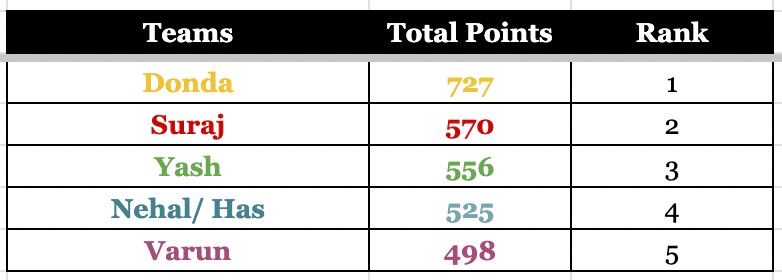
By 2024 the group had grown past ten, and we'd gotten slightly fancier. We used GPT to generate a logo for every team, so each one had its own little identity and the standings started to look like a real competition. The scoring, though, was exactly as manual as before. Nothing happened live. We pulled the data and computed the points whenever a few of us found a free evening, which meant the leaderboard was usually days behind the actual cricket.
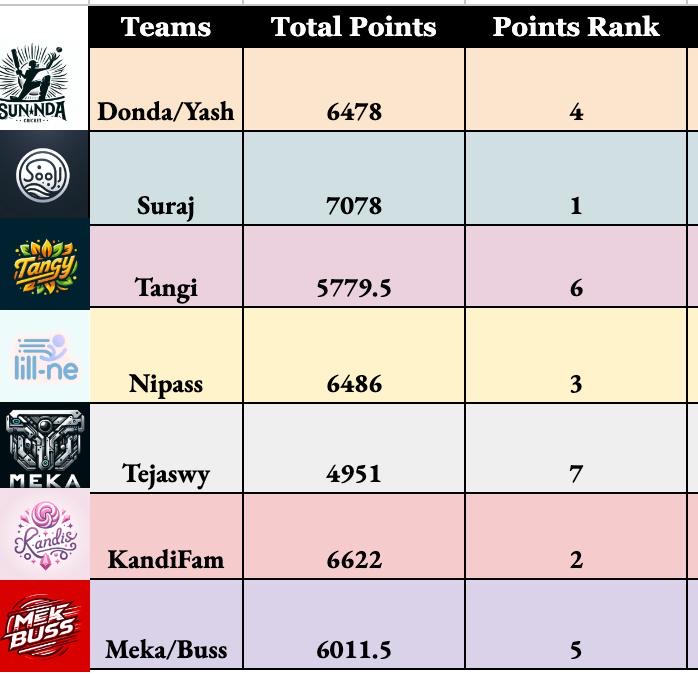
The problem was never how it looked. It was the lag. Fantasy cricket only works if the scoreboard is alive, if a wicket in the 14th over shows up on your team in the next minute and you feel it. Ours updated three days after the fact, which is another way of saying it didn't really work at all.
Chapter 2So we built the thing we kept wishing existed
In 2025, a friend I'd played with for years and I decided to stop doing it by hand. We wired in live APIs for the match data and built an actual app on AppSheets, Google's no-code tool. It wasn't pretty, but it worked: the points recomputed after every ball, and the three-day lag finally went to zero. We ran three groups that season, and it was the best one we'd ever played.
And because the rules were finally ours, we could change them. We'd always run a snake draft, where the player you pick is yours and nobody else in your league can have him. That one rule is what sets it apart from the salary-cap fantasy apps most people know: it stops being a solo puzzle against the stats and becomes a rivalry against your friends. You're not optimising a lineup, you're denying the guy next to you the player he wanted. That year we pushed it further, to a hybrid format, the top players went to a live auction and everyone drafted the rest.
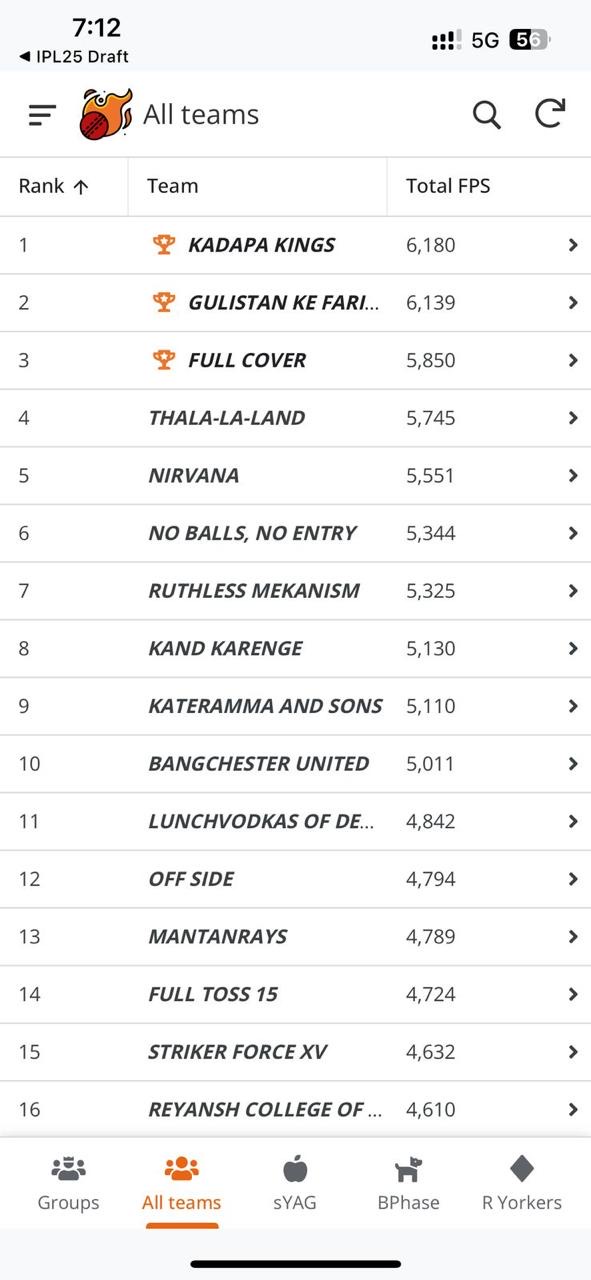
No cash contests. No strangers. No gambling loop. The prize was a year of bragging rights, which, if you've ever been in a group of competitive friends, you know is a far more powerful currency than money.
Chapter 3Then we ran a whole IPL season on it
Over those three years, our group went from five people to eighteen. AppSheets had carried us much further than a spreadsheet could, but it was starting to creak under everything we asked of it. So we rebuilt the whole thing properly, a real app this time, coded from scratch.
By then it was obvious we weren't the only ones with this problem. We just happened to be the ones who'd built the way out.
We kept adding to it. Cricket Clash, a quick one-on-one mode. Daily challenges and quizzes for the gaps between matches. A season Wrapped to argue about at the end. We tested all of it quietly through the T20 World Cup, watched what broke, and fixed it.
Then came the real exam: IPL 2026. Six leagues got set up, five of them ran the full season, 35 players in all, our core eighteen plus the friends they brought along. Two months, dozens of matches, live, every single day, in front of people who would notice the instant something broke.
Chapter 4What 35 players actually do
Thirty-five players is a small number, and I'll come back to that. But here's the one that made the whole thing worth it: on a typical match day, three in five of them opened the app, and on the best days more than eight in ten. Match after match, for two months, most of the league kept turning up.
That's the number I'm proud of, and it isn't close. Not a launch spike, not a vanity follower count, just a small group that chose to come back, game after game.
And because I built the analytics myself, I can see exactly what they do once they're in. About 70% of the active users are what I started calling scouts. Their session has a signature: open the standings, tap into a rival's squad to see who he's got, back out to standings, into the next rival's squad, and around again. That one loop, standings to roster and back, is 22% of everything that happens in the app.
They came to win, so they spend their time studying the competition. When a match is live it gets even more intense: a single session runs anywhere from 33 to 200 actions, and the most engaged stay in for close to an hour. During a game, the phone does not get put down.
I built a leaderboard. They turned it into a way to keep tabs on their friends. That's the good kind of surprise.
Chapter 5On building for the people in the room
The instinct, when you build something, is to chase the big number. More users, more signups, a screenshot that makes strangers nod. I had that instinct too.
This project taught me the opposite lesson. Thirty-five players is small by any standard you'd put in a pitch deck. But three in five of them came back for every match, the most engaged spent close to an hour inside something two friends built, and they obsessively scouted each other. That isn't a small thing. As far as I can tell, that's the whole thing.
The people I built it for were never a market, just the friends who kept asking me when the scores would be ready. And it turns out that group, the ones who've tried to run a league off a spreadsheet and quietly given up, lives in every circle of friends.
There's a lot I left out of this one. The part I least expected to spend my time on was the marketing, of all things: we took our Instagram from zero to 154 followers, and past 100,000 views once we put a little spend behind our best-performing reel, all of it content the app makes itself.
The scores update after every ball now. Nobody asks me when I'll get around to it. For a build that started as a way to stop being nagged, that alone was worth it.